
What are the 7 types of Digital Marketing?
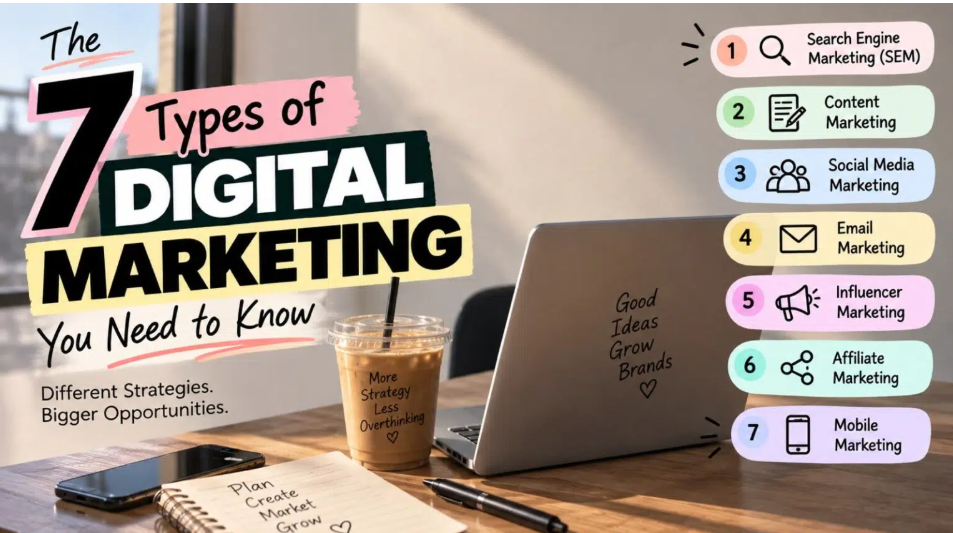
The seven commonly used areas are SEO, search engine marketing, social media marketing, content marketing, email marketing, affiliate marketing and influencer marketing. Each one reaches customers differently. If you’re a student in Pune, understanding these areas can help you choose what to learn and where you might fit.
You don’t need to know everything before you begin. That’s good new
The 7 types of Digital Marketing?
Digital marketing is simply marketing done through digital channels. A business can use Google search, Instagram, email, websites or online advertising to find and communicate with customers.
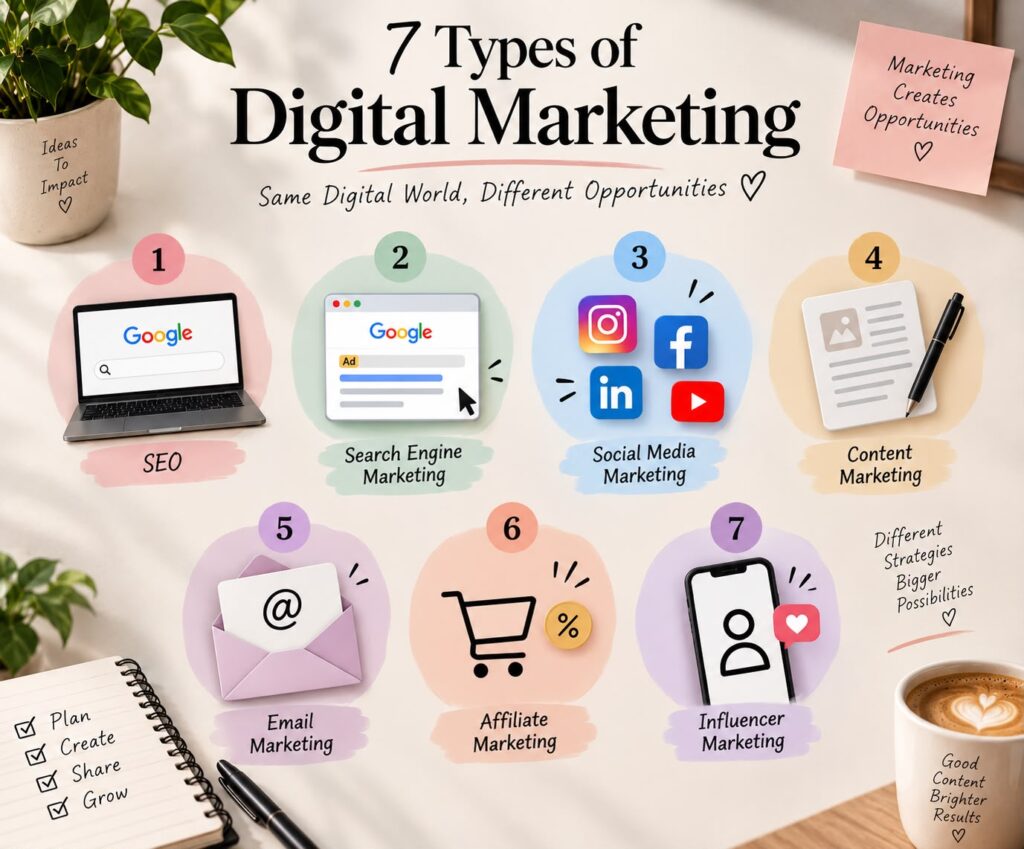
Here are the seven types of Digital Marketing :
| Type | What you do | Common tools | Example |
|---|---|---|---|
| SEO | Improve a website’s unpaid search visibility | Google Search Console | Ranking for “cafes in Pune” |
| Search engine marketing | Run paid search campaigns | Google Ads | Showing an ad for a local service |
| Social media marketing | Create and manage social content | Instagram, Meta Business Suite | Promoting a clothing collection |
| Content marketing | Create useful content for an audience | WordPress, Canva | Publishing a how-to article |
| Email marketing | Send useful or promotional emails | Brevo, Mailchimp | Sharing a sale with subscribers |
| Affiliate marketing | Promote products for a commission | Affiliate networks | Earning from tracked referrals |
| Influencer marketing | Work with online creators | Instagram, YouTube | A creator reviewing a product |
These areas can overlap. Imagine a small saree business in Pune. It could publish an article about choosing a saree for a wedding, optimize that article for Google, post a Reel showing the collection, and email existing customers about a new arrival. Same business. Different channels.
The 7 types explained with real examples
1. Search engine optimization (SEO)
SEO helps a website appear in unpaid search results. You might research keywords, improve page content, fix website issues and make pages easier for search engines to understand.
Suppose a local salon wants people to find it when they search for “hair salon in Kothrud”. Creating a useful location page could be part of its SEO work. SEO usually takes patience. You can’t pay Google to guarantee an organic ranking.
2. Search engine marketing
Search engine marketing usually refers to paid search advertising in beginner-level digital marketing courses. Google Ads is the obvious example.
A coaching class in Pune could create an ad for students searching for a particular course. The advertiser pays according to the campaign setup and bidding system. The advantage is speed. The downside is cost. A badly targeted campaign can spend money without generating enough enquiries.
3. Social media marketing
This involves planning and publishing content on platforms such as Instagram, Facebook, LinkedIn or YouTube.
For a fashion brand, one person might create Reels, write captions, reply to comments and check which posts receive useful engagement.
Social media can be fun, but it isn’t simply “post every day”. You need a reason for each piece of content.
4. Content marketing
Content marketing uses useful information to attract an audience. Blog posts, videos, guides and newsletters can all be used.
A student could create a blog called “Digital marketing courses in Pune: what to check before enrolling”. That one project could help practice research, writing, SEO and basic content planning.
That’s a much better learning exercise than copying definitions into a notebook.
5. Email marketing
Email marketing lets businesses communicate directly with people who’ve signed up to receive messages.
An online ethnic-wear store might send a welcome email after someone subscribes, followed later by a product update. The business can track things such as opens, clicks and conversions depending on its email platform. The catch? Nobody enjoys receiving irrelevant emails every day.
6. Affiliate marketing
Affiliate marketing is based on referrals. You promote a product or service through a tracked link, and the programe may pay you a commission when a qualifying action happens.
For example, a creator could review a digital marketing book and include an affiliate link. If a reader purchases through that link, the creator may earn a commission under the programe’s rules.
You still need traffic or an audience. A link sitting on an empty website won’t magically produce income.
7. Influencer marketing
Influencer marketing involves brands working with creators who already have an audience.
A Pune fashion creator might feature an ethnic-wear brand in an Instagram Reel. The brand may pay for the collaboration, provide products, or use another agreed arrangement.
Follower count isn’t enough to judge a creator. Audience fit and the quality of the content matter too. So, What are the 7 types of Digital Marketing? They’re seven common ways businesses attract attention and communicate with customers online. You can learn them together, then specialise in the area you enjoy most.